
In this article
The question
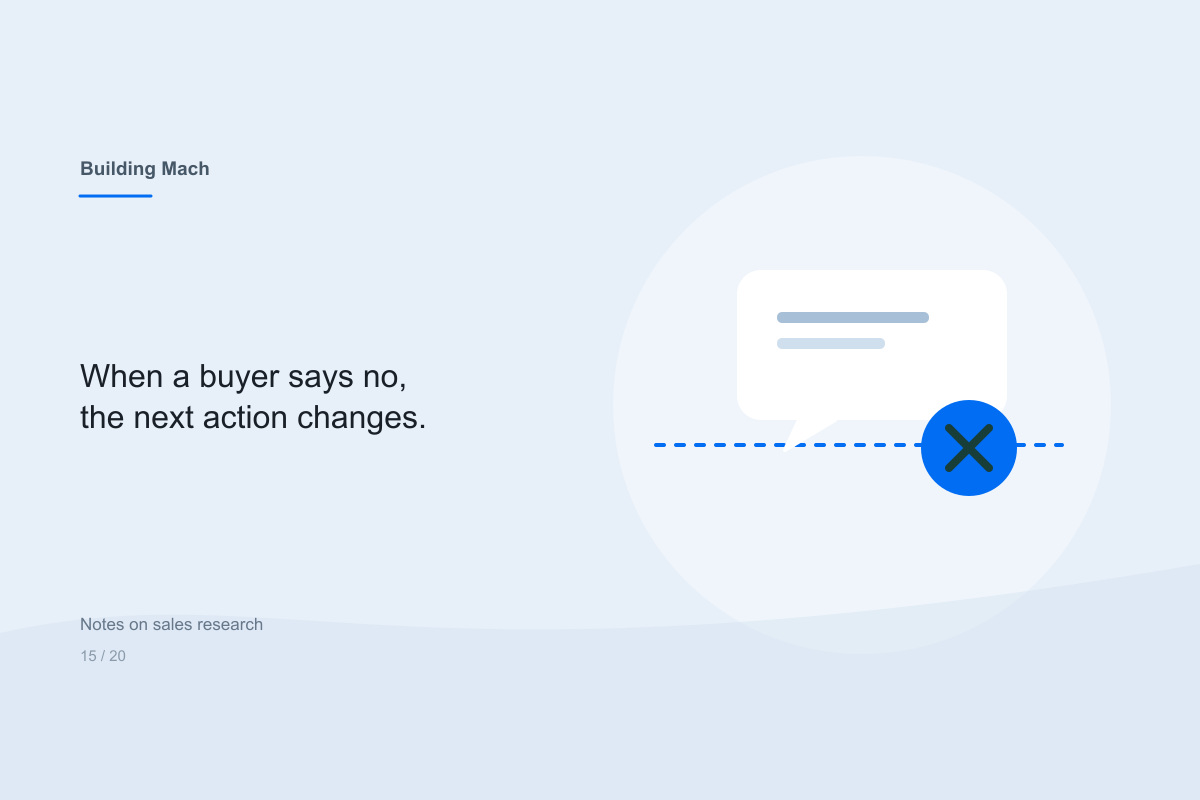
I want a buyer's answer to change the work we do next. If they ask us to stop, that request needs to reach the queued work, the next seller and the relevant systems that might act on it.
At Salesken, I led engineering, data science and product for conversational AI in sales. The working rule I bring to Mach is to keep the buyer's actual words beside the next-action decision. "Not a priority," "next quarter" and "do not contact me again" give the seller different boundaries to respect.
I want the record to preserve the wording, scope and owner, with uncertainty visible when a request is unclear. The next seller needs enough context to understand what the buyer actually said.
Read the boundary the buyer set
In an r/sysadmin discussion[1], a poster whose account is now deleted said they had told a seller, "please dont call or email again." They reported that the seller stopped calling them but then contacted their team. The post says the request concerned the organization.
In a separate r/cybersecurity discussion[2], another deleted poster wrote, "Vendor keeps sending email even after unsubscribed." Both reports are unverified. They do not establish which person or system caused the later contact, or a legal conclusion about the event.
I would assign an owner to a stop request, preserve its stated scope and check what is already planned. It is possible for one person to receive the answer while other work continues, but these reports do not establish that handoff failure as their cause.
My read is that the buyer's words should change the available next actions before the team looks for another message to send.
These replies are fictional. They show the judgments I would want a seller to make.
| Buyer response | What I would record | What I would check next |
|---|---|---|
| "Not a priority." | The proposal was declined. | Close the current push and preserve any further instructions. |
| "Please check back next quarter." | A proposed follow-up time and its context. | Assign an owner and recheck the context before contacting. |
| "Please do not contact me again." | A stop request with its stated scope. | Stop affected work and examine connected channels and records. |
| An unclear request | The wording and an owner for review. | Pause affected activity while the team determines how to honor it. |
A refusal of the proposal does not tell me everything about future contact. A proposed later conversation does not give unlimited permission. An explicit stop request should not be converted into a new route through a colleague.
The scope can concern a person, a list, a channel or the organization. "Remove me" may need interpretation. I would keep affected outreach paused while an authorized owner resolves that ambiguity. Silence does not clarify it.
Carry the answer beyond the inbox
A reply can arrive by email, in a meeting, on the phone or through a colleague. I want the recipient of that answer to have a clear way to record the person, date, wording, scope, source and responsible owner. Sensitive detail should stay with people who need it.
Then I would look at the work already in motion. Is a message scheduled? Is someone else contacting this person? Are there duplicate records? Does a separate channel or provider need the update?
A note that no sending decision reads is an unfinished handoff. The team needs to know which state changes, who changes it and how queued work is handled while systems are out of sync. I would check those steps in the actual setup before relying on a promise that contact has stopped.
Consider a fictional buyer replying to an account executive while a separate tool has an email queued. The executive reads the answer, but the tool has not received the update. Recording the preference is necessary; the next judgment concerns the work that can still act on the old information.
Where the current Mach checks help
The inspected playbook logic gives explicit opt-outs and ordinary replies different paths during active work.
| Recorded condition during active work | Branch in the source |
|---|---|
| Opt-out or email complaint | End the person's run as OPTED_OUT, before ordinary reply handling. |
| Meeting booked | End the person's run as MEETING. |
| Ordinary reply | Plan a configured reaction when drawn, then end as REPLIED without waiting for it to finish. |
Those branches depend on receiving the right recorded condition. A reply and an opt-out need to stay distinguishable as the answer enters the system. A seller reviewing an ordinary conversation also needs to see what was actually said.
The separate channel stop check reads do-not-contact status, a company stop and, for email, address-level suppression. A failure to read required information raises an error rather than returning permission to continue.
I want that close-to-action check because an earlier decision can become stale while a message waits. It remains only one part of the handoff. The request has to reach the right record, and the provider has its own queued-work behavior. This source inspection does not establish complete coverage or instant propagation across channels.
Test the handoff you intend to rely on
My suggested test starts with a controlled contact and a safe environment. Write down the systems involved so the test has a defined scope.
Step 1: Schedule a future test step and record its channel and sender.
Step 2: Simulate an explicit stop request through the normal intake path.
Step 3: Check the contact, duplicate records and relevant suppression state.
Step 4: Attempt the next test action and inspect the decision and reason.
Step 5: Repeat for the other channels and providers in use, investigating delays or missing handoffs.
I would test an ordinary reply separately from a stop request. Handing a conversation to a seller and honoring a no-contact preference can require different state. Keep evidence of each result so the test can be repeated after a workflow changes. This article does not report that test as performed or passed.
In the United States, the FTC's CAN-SPAM guide[3] covers B2B commercial email and requires honoring an opt-out within 10 business days. That deadline does not tell the seller to keep contacting someone during the intervening days. My operating bar is to stop affected work promptly and resolve queued activity. Other jurisdictions and channels need their own assessment.
Reviewing each person in an approved playbook covers the earlier decision. Who is already talking to this buyer? covers ownership when another teammate receives the answer. The buyer's response can change both.
How this post was made
AI assisted research and drafting from my background notes and the linked public material. The two quoted Reddit bodies were available on 5 November 2026 with both authors shown as deleted; their reports remain unverified. Implementation details use source version 58fc9baf04e8. The examples are fictional, and no cross-provider request-propagation test was performed. The first-person rules describe my intended standard, without a promise that every connected channel already meets it.
Which systems would you check for queued messages after a buyer asks to stop?
Common questions
Does “not now” mean never contact them again?
Record the wording and context. If the buyer proposes a later conversation, capture its purpose and timing without treating it as unlimited permission. Follow any stated restriction and applicable rules before deciding on a future approach.
How is an ordinary reply different from an opt-out?
A reply can open a conversation or decline the proposal without expressly addressing future contact. An opt-out states a contact preference. The inspected Mach logic distinguishes their consequences, so the intake path needs to preserve that distinction rather than classifying every answer as the same event.
Is an email unsubscribe sufficient across every channel?
Check the request's wording, scope and the systems that receive it. An email-specific mechanism does not establish what a phone or social tool knows. A broader request needs an owner who can stop applicable work across those tools, following the rules for each channel.
What if a message was already scheduled?
Inspect and stop affected queued work where the system supports it, then verify the next attempted action. A previous scheduling decision does not resolve a later stop request. Do not assume that updating a CRM field automatically cancels a message held by a separate provider.
Can another seller contact a colleague after a buyer says no?
First establish whether the request concerns the individual, the organization or another stated scope. Respect a broader restriction and coordinate with the account owner. Contacting a colleague to get around the person's request can repeat the problem described in the system administrator's report.
What should happen while an unclear request is reviewed?
Pause affected outreach and assign an owner to interpret and record the instruction. Preserve enough of the original wording to avoid repeated guesses. Resolve the scope using the team's authorized process; do not continue sending merely because a reviewer has not finished.
Does a suppression check prove every connected tool will stop?
It proves only what the checked path does with the state it can read. Verify receipt, matching to the right person, propagation to each relevant system and the next attempted action. The inspected Mach guard does not by itself establish provider coverage or end-to-end compliance.
Sources and further reading
- Deleted poster reports a stop request and later team contactReddit / r/sysadminBack to text
- Deleted poster reports email continuing after unsubscribeReddit / r/cybersecurityBack to text
- CAN-SPAM Act: A Compliance Guide for BusinessUS Federal Trade CommissionBack to text