In this article
The question
If a colleague has a meeting with a buyer next week, I want Mach's research to help that meeting. A fresh detail about the company can improve the agenda, suggest a question or change the preparation. It needs a reason before it becomes another conversation with the same buyer.
That is the judgment I want research to support. The source of a new clue, the person it concerns and the relationship already underway all belong in the next move. Finding something worth saying does not settle who should say it.
I would start with the owner of the conversation. Research can help that person decide what the buyer needs next, even when the right result is to prepare for the meeting and send no new introduction.
Give the owner something they can use
Consider a fictional seller who finds a hiring post from an account. The post names a workflow the seller understands. A colleague already has a meeting booked with an operations leader there.
I would want the source, date and relevant passage sent to the meeting owner, with a short question about what it might change. "The role mentions responsibility for this handoff; is that already on the agenda?" preserves what the source says and leaves its relevance open. A claim that the company is struggling with that handoff would need evidence the job ad may not provide.
The meeting owner might use the finding, know it is old or explain that another team owns the work. Each answer improves the next decision. Starting a separate cold thread before that check could leave the buyer explaining our own relationship back to us.
The record can make this harder. In an r/salesforce discussion about duplicate leads[1], u/girlgonevegan wrote[2] that "inbound activity cannot easily be attached to the correct lead record when duplicates exist." u/-EVildoer asked[3] whether several people might reach out to the same person at once. That was a question, not a report that duplicate outreach had happened.
My read is that the next seller needs enough relationship context to find the right owner and understand the proposed action. I want gaps in that history to stay visible, with an owner who can help resolve them. The comments raise that problem; they do not establish how often it happens or a record design that will fix it for every team.
Read the person and the account
I would examine the specific contact first, then the account. A scheduled meeting, an open opportunity and an unanswered email tell different stories. A note from 2 years ago can be useful history while leaving today's relationship unknown.
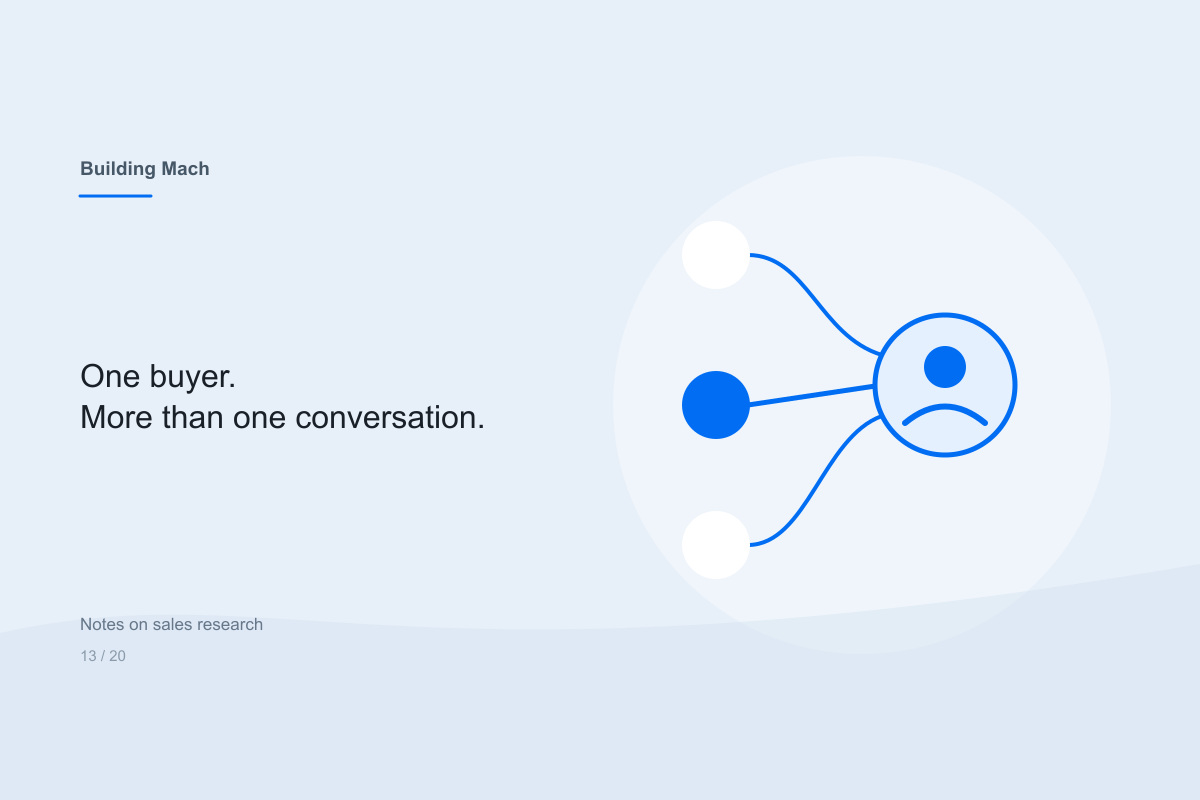
The company can also have several valid conversations. Procurement may be working on an existing deal while an operations leader has a separate need. I want the account plan to help a seller coordinate that work without pretending every person shares one conversation.
| What the team finds | What I would want research to help with | Next owner or action |
|---|---|---|
| A meeting with this contact next week | Prepare a relevant question with its source. | Ask the meeting owner whether it belongs in the agenda. |
| An open opportunity with another team | Understand the account plan and buying roles. | Agree with the deal owner who approaches whom. |
| A recent unanswered message | Understand what was already asked. | Review the sender's planned follow-up. |
| An old note with no owner | Establish the current relationship. | Find someone who can verify its status. |
| A contact preference | Preserve the buyer's stated boundary and scope. | Use the team's applicable controls before another action. |
Salesforce documents[4] contacts linked to multiple accounts and account teams with different roles and access. That is one example of why a company name alone cannot explain the relationship. A team using another CRM needs to understand its own links between the person, account, activity and owner.
I would keep sensitive detail out of a widely visible status. "Active conversation; ask the owner" may be enough to prevent a bad next action. The seller does not need every private negotiation note to know whom to ask.
What Mach can read, and what the seller still has to judge
Mach's relationship-steering logic reads meeting touches, notes, tasks and open deals. A recorded booked meeting directs the research toward preparation. An open deal directs it toward finding out where the deal stands from its owner. A recently held meeting directs it toward follow-up.
Those are useful instructions for research. Their quality depends on the records they read. Some meeting context is inferred from words and dates in notes or tasks; it is not necessarily a confirmed calendar event. An empty record also cannot establish that no conversation exists elsewhere.
The person-addition and run logic has related conditions for meetings, open deals, another running playbook and recent conversations. It can hold activity when another person at the buyer account has replied, or for a configured period after a message to another person there. Those conditions concern the buyer's colleagues. They do not establish that our sellers coordinated or that someone notified the owner.
I want a hold to explain what needs to happen next. "Hold until Tuesday while the account owner reviews the research" gives another seller a way forward. A temporary hold also needs a review date or event. Otherwise an unresolved status can keep the account in a queue long after the original reason has changed.
Leave a handoff that survives the meeting
The handoff I would ask for is small: the reason, owner, next action, scope and review date. In the fictional meeting example, it might say, "Existing conversation with this contact; the meeting owner will review the research before any new outreach."
After the meeting, keep what the buyer agreed, who acts next and when that action is due. If the buyer asks for no further contact, record and honor that preference through the relevant controls. Keep restricted details where they belong.
I would test the handoff by asking another seller to identify the next owner and action from the record. If they have to reconstruct the conversation from several inboxes, the handoff still needs work.
An approved playbook still needs to check each person follows the same responsibility when the team is about to start a sequence.
How this post was made
AI assisted research and drafting from the supplied product rules. Public passages and source version 58fc9baf04e8 were reviewed on 5 November 2026. The original Reddit post body was unavailable, so its former wording and attribution were removed; the surviving comments are linked above. The seller scenario is fictional. Record completeness, live provider coverage and owner notifications were not tested, and the first-person statements describe my design view.
Could the next seller identify the conversation owner and next action from the record you leave today?
Common questions
Does an open deal mean nobody else can contact the company?
Coordinate with its owner and review the account plan before deciding. The specific person may have a different buying role or need. An open deal is evidence of work underway, rather than proof that every contact shares the same conversation or permission.
What if the CRM has no recent activity?
Check with the relevant owner when possible. An empty record does not prove that no conversation exists in an inbox, calendar or another tool. Record what was checked and the remaining uncertainty instead of labeling the account untouched.
How should we handle duplicate contact or lead records?
First identify which records represent the same person and where their activity and preferences live. Use the CRM's supported process and an owner who understands connected systems. The Reddit discussion raises activity-routing problems; it does not establish a universally safe merge procedure.
What belongs in a widely visible status?
Enough to prevent an inappropriate action and find the owner: the relationship's status, scope, next action and review date. Keep sensitive details in the appropriate restricted location. A seller can learn whom to ask without receiving every private note from a negotiation.
Who owns research found while another seller has the conversation?
Share the source with the conversation owner and agree how it will be used. The person who found the information need not become the sender. Useful research can improve meeting preparation or follow-up without opening another thread with the buyer.
When should a coordination hold expire?
Tie review to a named owner and a concrete date or event, such as the scheduled meeting. Expiry should prompt a check of what happened. It should not automatically turn an unresolved conversation or a contact restriction into permission for cold outreach.
Do Mach's relationship checks prove our tools are coordinated?
They show places where inspected source uses recorded context. They do not establish complete CRM coverage, current data in every provider or a notification to the account owner. Trace a controlled example through your own records and the next proposed action before relying on the handoff.
Sources and further reading
- Duplicate leads and task management: surviving discussionReddit / r/salesforceBack to text
- girlgonevegan on inbound activity and duplicate recordsReddit / r/salesforceBack to text
- -EVildoer asks about simultaneous outreachReddit / r/salesforceBack to text
- Understand Account and Contact RelationshipsSalesforce TrailheadBack to text