
In this article
The question
I care about who can move this particular purchase forward. A list of senior titles leaves that question open.
For Mach, I want the buying map to reflect the decisions involved: who understands the work, who can fund a change, who evaluates it and who needs to approve it. Research should help a seller find those responsibilities and the questions still unanswered.
That also means being candid when Mach’s own rules make an assumption the seller should challenge.
Ask how the purchase gets decided
In an r/sales discussion[1], u/bobushkaboi described a supporter expecting leadership to approve their choice. Later, the decision maker started “pushing back on capabilities, pricing, timeline, etc.”
u/Representative_note[2] suggested, “My strategy is to be a project manager for the buying process.” They described outlining the usual steps and asking the buyer how their process differs.
u/gradeAprime[3] proposed stopping until an executive-alignment meeting occurs. u/bitslammer[4] offered a different view from enterprise cybersecurity: a decision maker may have delegated the work to the contact already involved.
I would begin with the process question. The supporter may be right about their mandate. They may also be missing a review that will matter later. An executive meeting can help in some purchases; insisting on one can ignore how another organization delegates the decision.
These are individual reports and methods. My read is that the seller needs to learn the mandate, criteria and remaining approvals before deciding that a title is missing from the call.
Map the work before assigning authority
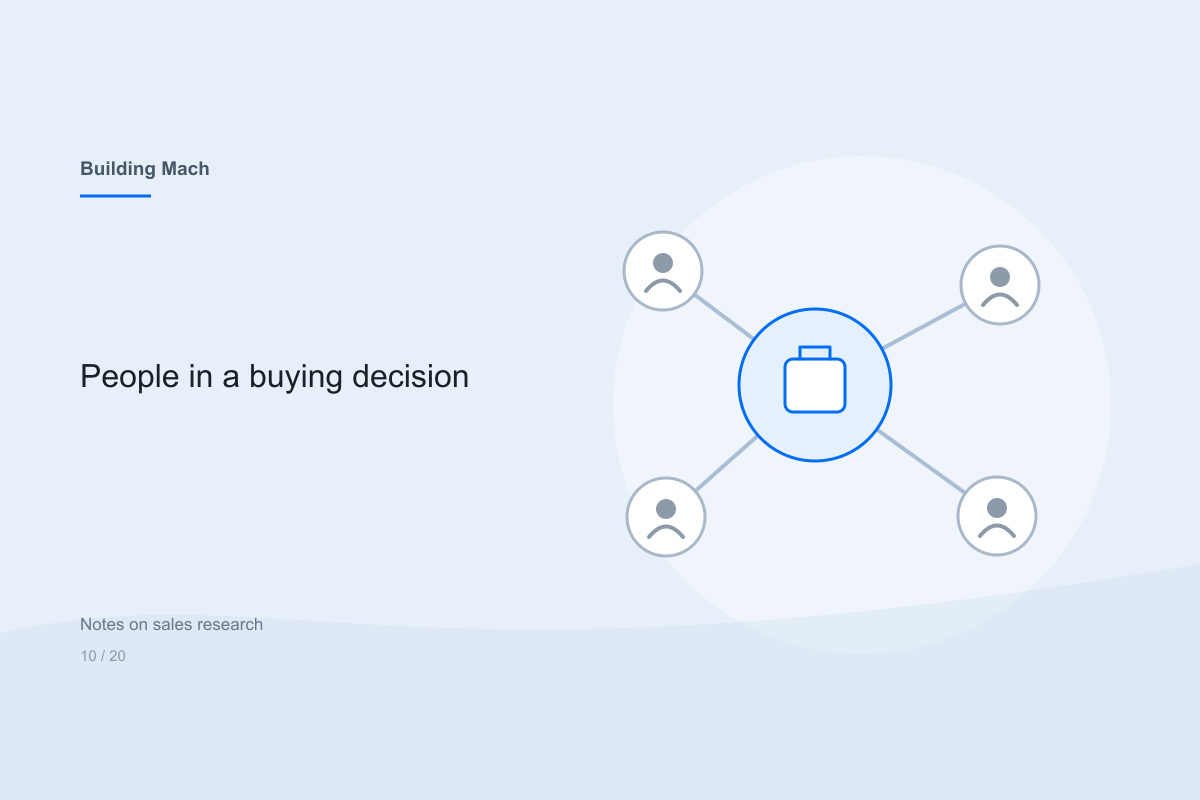
Consider a fictional retail company evaluating employee scheduling software. I would use the map below to prepare questions. None of the responsibilities is confirmed merely by finding a matching title.
| Possible participant | Decision they may inform | What I would want confirmed |
|---|---|---|
| HR or workforce lead | Whether the process meets workforce needs and policies | Do they own the problem or evaluation? |
| Finance leader | Funding and the business case | Who controls the budget and what evidence is required? |
| IT or security lead | Integration, access and data review | Which review applies, and when? |
| Store manager | The daily work of assigning and changing shifts | What is difficult, and does it matter enough to change? |
| Legal or procurement | Contract and purchasing process | Are they involved, and what must they approve? |
One person might cover several responsibilities. Workforce administration might be outsourced. A small company’s owner might make the purchase. I want research to keep these possibilities open until the buyer explains the process.
The product changes the map as well. HR may be central to scheduling and peripheral to an infrastructure-monitoring purchase. IT may lead one evaluation and review a narrow part of another.
In his Salesforce discovery guide[5], Marcus Chan separates the economic decision maker, champion and approvers. I would use those responsibilities as questions to investigate, with the buyer’s process determining who fills them.
Give the supporter a useful next step
An enthusiastic contact can understand the work and still need help building the case. I would want to learn what happens next, who needs to be comfortable with the change and what would make another conversation useful.
I would ask:
• How have comparable decisions been made here?
• Who else would feel the effect of this change?
• What review would need to happen before you could proceed?
• What would make a conversation with that person useful for them?
The answers can be incomplete or change. I would keep them as the contact’s account of the process and agree on useful introductions. Finding a possible participant does not tell me that contacting them immediately is appropriate.
For the fictional retailer, the store manager may explain the daily process. Finance may explain funding. IT may explain a review. Each conversation needs a reason the participant can recognize.
Where I would challenge Mach’s map
Mach’s configurable research-agent model can represent possible roles, whether someone owns the problem, their stance and a suggested contact order. Those are useful places to store a working theory and its evidence.
There is also a limitation in a shared title rule. It classifies certain HR, recruiting and legal titles as unrelated without considering what the seller offers. Both research paths use the rule.
For the scheduling example, that assumption can exclude a relevant person. My read is that the rule is too broad for that purchase. I would check those classifications before relying on the map.
I want the product judged against the actual decision, including where its implementation falls short. A buying map still needs review if a relevant function was removed before the seller saw it. This source finding does not establish what happened in any particular live account.
A found person and an added contact are separate choices
The inspected research code can research an account without proposing new people. When proposals are enabled, workspace settings can leave them for review, add the best deciding person when the account has no contacts, or add eligible people across the seats found.
I would check that setting before running research. It controls which records are added. It cannot establish someone’s authority, priorities or willingness to talk.
My bar for using a person in an outreach decision is the evidence behind their role and the relationship context. Record creation is one part of that work.
Method and scope: Role structures, the shared title rule and contact settings were checked against the November 5, 2026 source snapshot. The detailed role model belongs to the configurable agent; a separate path is configured as the default. No live account or contact-addition workflow was exercised.
Keep the gaps useful
For the fictional account, I would want the note to separate the person’s possible role, what they have said and the decision that remains open.
| Note | What it permits the seller to do |
|---|---|
| Workforce lead described a manual review step | Ask whether changing it is a priority |
| Workforce lead suggested finance join | Prepare a useful funding conversation |
| Budget owner unknown | Ask how a comparable purchase is funded |
| Account owner already knows finance | Coordinate internally before arranging an introduction |
A suggestion to involve finance is different evidence from finance approving a purchase. I want that distinction preserved, just as I want a buyer’s words kept separate from our inference.
For the next account, I would begin with the decision and one person who can explain part of it. Add people when a specific responsibility or unanswered question makes their involvement useful. Leave an unfilled role visible until there is evidence to fill it.
Which role in your next buying decision is still a guess based on a title?
How this post was made: AI assisted the research and drafting from supplied product principles. Public quotations and handles were checked on November 5, 2026. Implementation details were checked against the dated source snapshot. The fictional examples are labeled.
Common questions
Does the most senior person always approve the purchase?
Authority can be delegated and depends on the purchase. Ask how the organization made a comparable decision, which reviews applied and who could approve it. A senior title alone leaves those questions unanswered.
How many people belong on the buying map?
Include people whose work or responsibility could change the decision. One person may cover several roles, while a complex purchase may involve more than the five participants in the illustration. Leave an explicit gap when a relevant responsibility has no confirmed person.
Is an enthusiastic supporter always a champion?
Record what the person has done and what access or influence they have demonstrated. Enthusiasm helps a conversation, but it does not establish that they can move a purchase through the organization. Ask what they need to make the next step useful.
What if the decision maker delegates the evaluation?
Learn the team’s mandate, decision criteria and escalation process. Work with the people authorized to evaluate the purchase. Ask when an approver would need to participate instead of treating an executive meeting as a universal requirement.
Should we contact everyone on the map?
Use the map to understand the decision and agree on useful introductions with the people already involved. Give each proposed conversation a purpose. A name and a possible role provide context, not evidence that the person wants outreach.
Does finding a person in Mach always leave them as a proposal?
The inspected code makes that depend on the run and workspace settings. Research can omit new proposals, leave eligible people for review or add eligible contacts under the selected rule. Check the setting before running research.
When should the map be updated?
Update it when a person confirms a role, leaves the company, introduces a colleague or describes a new review. Preserve who supplied the information and when. Revisit an assumed role before using it to make a consequential next step.
Sources and further reading
- u/bobushkaboi: late decision-maker objectionsRedditBack to text
- u/Representative_note: managing the buying processRedditBack to text
- u/gradeAprime: executive alignment meeting adviceRedditBack to text
- u/bitslammer: delegated decision authorityRedditBack to text
- Marcus Chan: discovery call guideSalesforceBack to text